


A ball valve is a valve that uses a spherical closure to control the flow of a medium. Its tightness, opening and closing speed, and wear resistance make it a key component in industrial control systems. Traditional ball valves mainly rely on manual operation or simple mechanical devices for opening and closing. Although they can meet basic needs in most occasions, in the era of mass production, intelligent control, and remote monitoring, traditional manual control methods can no longer meet the requirements of efficient automated production lines.
The development of automation technology has enabled various valves, including ball valves, to gradually achieve remote control and intelligent monitoring. Automated ball valves integrate electric, pneumatic, or hydraulic drive devices to seamlessly connect with the control system to achieve precise control of switching actions and real-time data feedback. This not only improves the operating efficiency of the system, but also has obvious advantages in equipment safety, energy utilization, and maintenance costs. As a result, how to achieve ball valve automation has become a hot topic in the process of industrial upgrading.
Content
1. Principle of ball valve automation
2.Electric Operated Ball Valve
1. Principle of ball valve automation
The core of ball valve automation is to add actuators to traditional ball valves so that they can automatically open and close according to control signals. The realization of automated ball valves mainly relies on the following technical means:
1.1 Application of electric actuators
Electric actuators are one of the most common driving methods in current automated ball valves. The principle is to provide power through an electric motor, and transfer the rotational energy to the ball of the ball valve through a deceleration and transmission system, so as to achieve precise opening and closing. Electric actuators have the characteristics of fast response speed, high control accuracy, and simple maintenance. At the same time, they can be connected to control systems such as PLC and DCS through digital signals to achieve remote control and data acquisition. With the development of energy-saving technology and servo control technology, the new generation of electric actuators has significantly improved in positioning accuracy and control stability.
1.2 Pneumatic and hydraulic drive technology
In some occasions that require fast response and high-frequency opening and closing, pneumatic and hydraulic drives have become an important supplement to electric drives. Pneumatic actuators use compressed air as the driving medium, with the advantages of simple structure, small size and light weight, and are suitable for some low-load and low-precision application environments. Hydraulic actuators transmit pressure through liquids, and usually show stronger thrust and more stable control performance under high loads or extreme environments. Although these two driving methods have certain limitations in energy consumption and maintenance, they can effectively make up for the shortcomings of electric actuators under special working conditions and provide more technical options for ball valve automation.
1.3 Control system and communication protocol
Automated ball valves not only require actuators to provide power, but also require advanced control systems and communication protocols to achieve remote monitoring and data interaction. By integrating sensors, control panels and communication modules, automated ball valves can transmit real-time operating data to host computers or cloud platforms to achieve status monitoring, fault warnings and parameter adjustment. Common communication protocols include Modbus, Profibus, CAN, etc., which not only ensure the stability of data transmission, but also meet the needs of different industrial sites for information interconnection. At the same time, modern control systems also use built-in algorithms to self-diagnose equipment to achieve preventive maintenance and intelligent decision-making.

The 110v motorized ball valve has a compact structure, is made of high-quality corrosion-resistant materials, and has strong durability. Its main application scenarios include water treatment systems, HVAC (heating, ventilation and air conditioning) systems and other industries, especially in occasions that require frequent opening and closing and precise flow control. The adaptability of 110V voltage enables it to be widely used in many small and medium-sized equipment and systems, ensuring efficient operation and stable control of the equipment.
Product Features
Voltage adaptability: The electric ball valve is suitable for 110V AC, widely compatible with the power systems of industrial and commercial places, easy to install, and no additional transformer equipment is required.
Automation control: Driven by electric actuators, remote automation control can be achieved, suitable for applications in industrial process automation systems, such as pipeline opening and closing and fluid regulation.
Quick response: The electric ball valve operates quickly and can complete the switching action in a short time, ensuring that the fluid flow or pressure of the system can be adjusted in time, reducing delays caused by manual operation.
Technical Parameters

◆Main material: forging brass body, seal PTFE / HNBR
◆ Actuator torque: 3.5N.m
◆ Valve opening torque: <1N.m
◆Nominal pressure: 1.6MPa
◆ Working medium: water
◆Fluid temperature 5~95℃
3.Electric Operated Ball Valve

Electric operated ball valves are used to control the terminal water circuit of air conditioners. The thermostat controls the electric valve motor and opens or closes the valve through the forward and reverse motor, thereby realizing the flow or disconnection of the medium in the pipeline, and then supplies air through the fan coil to achieve automatic temperature control. The valve body integrates dynamics and filtration, adjusts the water flow, and can balance the high and low pressures, and is equipped with a temperature measurement interface.
Product parameters
Main material: valve body forged brass, seal PTFE, EPDM
Nominal pressure: 1.6MPa
Driver torque: <2N.m
Valve opening torque: <1N.m
Working medium: cold and hot water, concentration <50% ethylene glycol solution
Medium temperature: 5~95℃
Valve stem size: 9x9mm
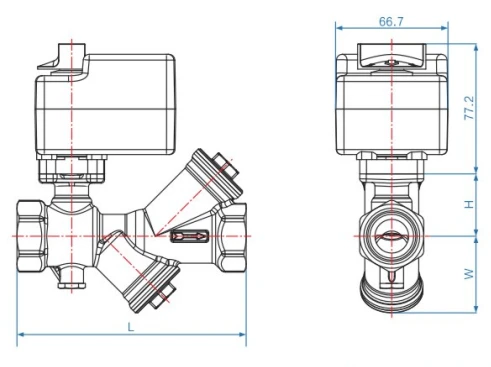
Product features
The structure is easy to install and saves costs.
The closing pressure difference is large and the closing is tight.
The integrated filter can effectively filter and remove impurities in the medium.
The integrated balancing valve can balance the high and low pressures.
The integrated filter and balancing valve save installation space and reduce installation costs.
At the same time, maintenance is more convenient.
FAQ
1. How fast does the electric operated ball valve respond?
The speed of the electric ball valve's response depends on the power of the actuator and the size of the valve, and the switching time is usually between 3 and 15 seconds. For larger-caliber ball valves, the response time may be longer.
2. Can the electric ball valve work under high temperature conditions?
Electric ball valves can work in high temperature environments, depending on the material and seals of the ball valve. Special high-temperature ball valves can withstand temperatures up to 400°C or more, but standard models are generally suitable for 0°C to 150°C.
3. Will the electric operated ball valve automatically close when the power is off?
Some electric ball valves have a power-off self-reset function, which automatically returns to the preset closed or open position when the power is off. But most standard electric ball valves will maintain their current switch state after power is off.
4. How to judge whether the electric operated ball valve is in the open or closed state?
Many electric ball valves are equipped with a position indicator that displays the current switch state of the valve. In addition, some models have a feedback signal that can feed back the switch state to the control system.
5. Can the electric ball valve be manually operated?
Most electric ball valves have a manual operation function, which can be used for switch control by manual operation when the electric actuator fails or the power fails.
6. What is the difference between an electric ball valve and a solenoid valve?
The electric ball valve is opened and closed by an electric actuator, which is suitable for working conditions with large flow, strong sealing and high pressure, and is suitable for frequent operation. The solenoid valve controls the opening and closing by the electromagnetic coil, which is usually used in small-caliber and low-pressure occasions, and has a faster response speed. Electric ball valves are usually used for precise regulation of fluid flow, while solenoid valves are used for switch control, and the application scenarios are different.
7. Can the switching speed of the 110v motorized ball valve be adjusted?
The actuators of some 110V electric ball valves can be configured to adjust the switching speed, usually by setting the electronic control module. Adjusting the switching speed helps to reduce the water hammer effect on the pipeline system, especially in large-caliber or high-speed flow occasions.
8. Will a 110V electric ball valve that has not been used for a long time get stuck when it is started?
If it has not been used for a long time, the electric ball valve may get stuck due to accumulated impurities or aging of the seals. To prevent this, it is recommended to manually or electrically operate the valve regularly to keep it in good operating condition, and clean and maintain it before long-term deactivation.
9. Can the actuator of a 110v motorized ball valve be replaced?
Yes. The actuator and valve body of an electric ball valve are usually separated. Users can choose electric actuators of different specifications or brands according to different control requirements or replacement requirements. However, when replacing, it is necessary to ensure that the torque, size and interface of the actuator match the valve.
10. How long is the life of a 110V electric ball valve?
The service life of an electric ball valve depends on the frequency of use, medium characteristics and maintenance. Generally speaking, a high-quality electric ball valve can be used for 10-15 years or even longer under normal operation and regular maintenance. Under harsh working conditions (such as high corrosion, high temperature, and high pressure environments), the service life may be shortened.