


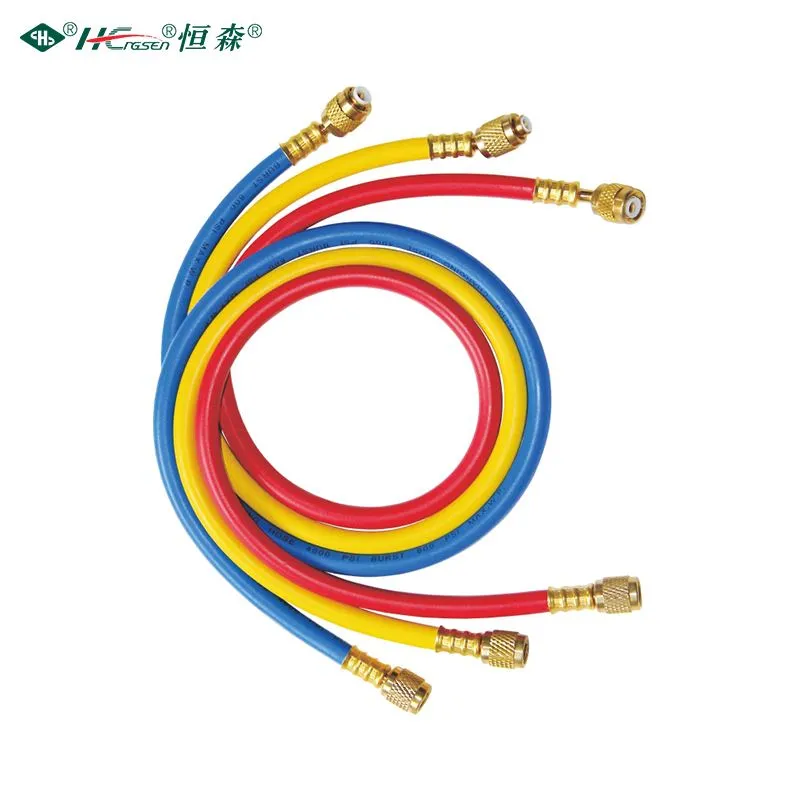
Refrigerant Charging Hose
Refrigerant Charging Hose is a special flexible pipe used to accurately transport refrigerants during the maintenance and installation of refrigeration equipment. Refrigerant Charging Hose has good flexibility. It can be flexibly positioned in a small space or complex pipeline layout, and is convenient for connecting refrigeration equipment and refrigerant storage containers. It is mainly used in the production and manufacturing of various refrigeration equipment such as air conditioners and refrigerators to ensure that the refrigerant is accurately filled into the equipment; during the maintenance of refrigeration equipment, maintenance personnel also need to use it to replenish or replace refrigerants and restore the refrigeration performance of the equipment to ensure the continuous and stable operation of the refrigeration equipment.
Zhejiang Hengsen Industrial Group Co., Ltd. is a high-tech enterprise specializing in the production of HVAC control products, pipe fittings, and refrigeration fittings. Hengsen is located in Zhejiang Zhuji, that is closed to Xiaoshan and Pudong international airports with good geographical and economic advantages. Through the in-depth implementation of the technical standards strategy, Hengsen accelerated the process of transformation and upgrading. Up to now, Hengsen has 5 subsidiaries, covering a total area of more than 80,000 square meters, with more than 500 employees and more than 100 professional technicians.
Why Choose Us
Rich Experience
We have more than 20 years of manufacturing experience in copper valves, water-heating pipes, and air-conditioner parts.
Broad Market
Hengsen has a number of offices in China, and its products have been supporting many Fortune 500 enterprises for a long time, and exported to South America, Europe, the Middle East, and other regions.
Professional Team
Professional team composed of professional technical personnel, from product design, and production to quality testing, every step of professional personnel responsible for.
High Precision
Professional equipment manufacturing high-quality products, automatic production, to ensure the beauty and quality of products.
Competitive Price
Manufacturers' direct sales can eliminate the intermediate steps, and provide the best service and affordable prices.
Good Service
We can provide ODM/OEM service according to customer requirements. Each customer has a person responsible for and is provided with a year after-sales guarantee.


A refrigerant charging hose is a specialized hose used in air conditioning and refrigeration systems to add or remove refrigerant from the system. These hoses are designed to withstand the high pressures involved in refrigerant handling and are typically equipped with fittings that allow for easy connection to refrigerant cylinders, gauges, and the system being serviced. Refrigerant charging hoses come in various lengths and sizes to accommodate different systems and applications. They play a crucial role in maintaining the proper levels of refrigerant in HVAC (Heating, Ventilation, and Air Conditioning) systems, ensuring efficient operation and optimal performance.

Benefits of Refrigerant Charging Hose

01
Safety
A compatible structure reduces the risk of refrigerant exposure and leakage hence saving your as well as your systems’ health by providing a secure connection.

02
Adaptability
Our hoses are compatible with all refrigerant types. You don’t have to worry about your refrigerant type as we have a charging hose for each HVAC unit.

03
Efficiency
Our charging hoses are extremely effective as they provide efficient charging and servicing hence improving overall system performance.

04
Reliability
We only source from reputable and trusted brands to ensure the functionality and reliability of our charging hoses.
Common Types of Refrigerant Charging Hoses
Flexible Refrigerant Hoses
Flexible refrigerant hoses are just that – flexible. They can bend, making them great for tricky installations and tight spots. It makes these hoses easier to install and less likely to crack or break when they’re moved around. It is mostly made of synthetic rubber or polymers. These materials give the hoses their flexibility, while still being strong enough to handle high pressures.
Rigid Refrigerant Hoses
Another is rigid refrigerant hoses. Rigid hoses can handle even higher pressures than flexible ones. Plus, they’re super durable. Think of them as the strong, silent type of the refrigerant hose world. Rigid hoses are typically made of metal, like stainless steel or aluminum. These materials can withstand a lot of wear and tear and high temperatures.
Applications of Refrigerant Charging Hoses
Domestic HVAC Systems
In your home, the refrigerant hoses are hidden away, doing their thing in your HVAC system. It's thanks to them that you’re comfortable all year round.
Role of Refrigerant Hoses in Domestic HVAC Systems
In a home HVAC system, the refrigerant hoses transport the refrigerant around, making sure your house stays the perfect temperature. They’re the unsung heroes of your home comfort.
Commercial HVAC Systems
It's not just homes that need refrigerant hoses. Any building with an HVAC system needs them.
Use of Refrigerant Hoses in Commercial HVAC Systems
In a commercial setting, refrigerant hoses have the same job as in your home, but on a bigger scale. They keep offices, stores, and other buildings comfortable for everyone inside.
Industrial Cooling Systems
Industrial cooling systems have some unique demands, and refrigerant hoses are up to the challenge.
Significance of Refrigerant Hoses in Industrial Cooling Systems
In an industrial setting, refrigerant hoses might be cooling machinery, not people. But they’re just as important. They keep everything running smoothly and safely.
Enduring Construction
You can rest assured of the durability of our charging hoses. Our charging hoses are built of robust materials that can resist the wear and tear of time as well as prevent corrosion.
Pressure Handling
As our charging hoses are made up of high materials, they can handle high and low-pressure refrigerant exceptionally.
Varying Length Sizes
Our hoses aren't one-size-fits-all at all. We acknowledge the fact that different system configurations need different services, we have different brands providing different length sizes to accommodate your problems.
Leak Prevention
We provide secure fitting in our hoses as well as O-rings to avoid any leakage of gas during the charging or servicing process.
Hoses for air conditioners are often constructed from many layers of pliable but durable material. In addition to protecting it from the elements outside, this enables them to keep refrigerant within. The following layers are part of the layers that help guarantee the hoses' toughness.
Outer Layer: The rubber covering visible on the refrigeration hose's exterior is the outermost layer or outer cover. The coating shields the inner layers from harm.
Woven Fabric: Under the outer cover is a layer made of woven fabric. Its purpose is to give the hose structural support or strength.
Inner Layer: The layer closest to the refrigerant is the innermost layer. It's generally rubber and acts as permeation protection. Some refrigerant hoses may include a second layer of nylon beneath this layer.
Rubber is the material of choice for refrigerant hoses. They are hence exceedingly adaptable. Working with a flexible refrigerant hose is simple. It won't crack when twisted into various orientations for car AC system maintenance.
Maintenance Tips for Refrigerant Charging Hoses
Visual inspection of the hose and fitting
It is necessary to inspect the hose assembly regularly. If any of the following conditions are visible, the machine must be shut down immediately and the hose assembly should be replaced:
Fitting slippage on a hose;
Damaged, cracked, cut, or abraded cover (any reinforcement exposed);
Hard, stiff, heat cracked, or charred hose;
Cracked, damaged, or badly corroded fittings;
Leaks at fitting or in hose;
Kinked, crushed, flattened, or twisted hose; and
Blistered, soft, degraded, or loose cover.
Visual inspection of all other related hose assembly components
The following items must be tightened, repaired, corrected, or replaced as required:
Leaking port conditions;
Excess dirt buildup;
Worn clamps, guards, or shields; and
System fluid level, fluid type, and any air entrapment.
Functional test
Operate the system at maximum operating pressure and check for possible malfunctions and leaks. Personnel must avoid potentially hazardous areas while testing and using the system. Ensure that the hose is not operating outside of its published maximum working pressure and that surge or peak pressures are below this point.
Replacement intervals
Hose assemblies and elastomeric seals used on hose fittings and adapters will eventually age, harden, wear and deteriorate under thermal cycling and compression set. Hose assemblies and elastomeric seals should be inspected and replaced at specific replacement intervals, based on previous service life, government or industry recommendations, or when failures could result in unacceptable downtime, damage, or injury risk. They may also be subject to internal mechanical and/or chemical wear from the conveying fluid and may fail without warning.
Hose inspection and failure
Hydraulic power is accomplished by using high-pressure fluids to transfer energy and do work. Hoses, fittings and hose assemblies all contribute to this by transmitting fluids at high pressures. Fluids under pressure can be dangerous and potentially lethal and, therefore, extreme caution must be exercised when working with fluids under pressure and handling the hoses transporting the fluids.
Elastomeric seals
Elastomeric seals will eventually age, harden, wear and deteriorate under thermal cycling and compression set. They should be inspected and replaced regularly to protect the system.
Buying Guide for Refrigerant Charging Hoses
Price
Although it may seem simple, it's crucial to remember that you should look at something other than something's price and conclude that it needs to be more pricey. Instead, you must compare costs amongst suppliers and evaluate who gives more value for money!
Product Type
You can purchase a variety of short refrigerant hoses. Some are elementary, while others are sophisticated. Before making a purchase, you must ascertain the merchandise you require. For instance, a basic product is perfect if you want something straightforward. But let's say you want something more sophisticated. The more expensive one is preferable because it will offer extra functions.
Size
When selecting the best short refrigerant hoses for you or another person, consider the product size because every user has different needs. For instance, someone using large tools or products would require something larger than someone using smaller things or gadgets. Therefore, it's crucial to consider each product's size before buying it to ensure it will satisfy all your size needs and specifications.
Brand
You should purchase a branded product because it has already been tried and true by numerous consumers. Additionally, brands offer warranties on their short refrigerant hoses, ensuring that they will replace or repair your new item without difficulty if anything goes wrong while the warranty still covers it.
Durability
The lifespan of short refrigerant hoses is something you should think about. You must purchase something that will meet your demands for many years. A durable product will suit your purpose well if many individuals have used it without experiencing any problems.
Ease of Usage
Please make sure a short refrigerant hose is simple to use before purchasing it so that you don't have any problems using it. While some short coolant hoses appear fantastic, their complexity may exceed your proficiency or knowledge.
Our Certificate


FAQ
We're professional refrigerant charging hose manufacturers and suppliers in China, specialized in providing high quality custom service. We warmly welcome you to wholesale high-grade refrigerant charging hose from our factory.
Refrigeration Accessory, Ac Refrigerant Recharge Hose, Refrigerant Hoses With Ball Valves