


In fluid, air or gas control systems, valves are crucial components. From household sprinkler systems to complex mechanical systems such as space rockets, they all rely on the precise control of valves. When faced with valve selection, the right choice can not only improve system efficiency, but also effectively save costs. We have noticed that many customers have questions about the differences between electric ball valves and solenoid valves and how to choose. This article will analyze the core differences between the two and compare their respective advantages and disadvantages to provide a clear reference for your selection.
contents
1.What Is A Solenoid Valve?
2.Types of Solenoid Valves
3.Advantages of solenoid valves
4.What is an electric ball valve?
5.Types of Electric ball valve
6.Advantages of Electric ball valves
7.Comparison table: Solenoid valve vs. electric ball valve
8.FAQ
1.What Is A Solenoid Valve?

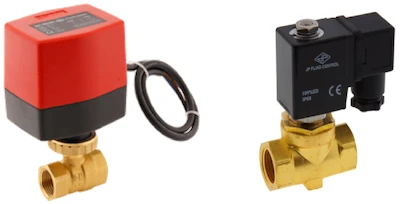
Magnetic Valve are automated valves that work by driving a solenoid through an electric current. As an electromagnetic coil, a solenoid generates a magnetic field to drive the plunger to move when powered on: the plunger of a normally closed solenoid valve closes the valve port when stationary, and the magnetic field moves the plunger upward to open the passage when powered on; the normally open type remains open when the power is off and closes when powered on. With its low power consumption, compact and durable structure, it can accurately control the distribution and flow of fluids, air, and gases, and is widely used in many fields such as industrial automation and fluid control.
2.Types of Solenoid Valves
There are three common types of solenoid valves, suitable for different fluid control scenarios:
Two-way solenoid valve: It has one fluid source inlet and one outlet, and only supports two states of "open" or "closed". The valve cuts off the fluid path when closed and allows the fluid to flow smoothly when open, which is suitable for simple on-off control scenarios.
Three-way solenoid valve: It has three ports and provides three control modes: normally closed, normally open and universal. Through the combination of different ports, the flow direction of the fluid can be switched or diverted, and it is often used in systems that need to change the fluid path (such as pneumatic control, hydraulic circuits).
Four-way solenoid valve: It functions similarly to a double-acting cylinder, usually including one or two exhaust ports, two cylinder interfaces and a pressure interface, and is equipped with related connectors. Its structural design can accurately control the complex flow of fluids between multiple ports, and is widely used in automation equipment that needs to drive actuators (such as reciprocating motion of cylinders).
3.Advantages of solenoid valves:
Quick response speed: It can be opened or closed in an instant, which is particularly suitable for high-efficiency scenarios such as emergency cut-off and automatic control.
Energy consumption is economical and efficient: It can maintain the default working state (normally open or normally closed) without continuous power supply, reducing the energy consumption cost of the system.
Significant cost advantage: Compared with similar control valves, it has high cost performance and is the preferred solution for small and medium-sized systems.
Sophisticated and compact structure: Small size and light weight, easy to install flexibly in narrow spaces or complex pipelines.
Easy and fast maintenance: Daily maintenance requirements are extremely low, and core components such as coils support plug-and-play replacement to reduce downtime.
High-frequency operation and stability: It can withstand dozens of switching cycles per second and adapt to industrial environments with high-frequency operations.
Flexible system integration: It supports seamless docking with automation systems such as PLC and DCS, and easily realizes remote control and intelligent management.
4.What is an electric ball valve?

The electric ball valve is an automated valve that controls the flow of fluid by rotating the ball driven by a motor. Its core structure is a ball with a central through hole. The motor drives the ball to rotate 90° around the axis to achieve full opening (the hole is consistent with the flow direction), full closing (the hole is perpendicular to the flow direction) or any opening adjustment. The valve does not require continuous power to maintain its position, has manual operation function, and has both automation and emergency operation capabilities.
5.Types of Electric ball valve
There are three main types of electric valves, which achieve fluid control in pipelines through different driving methods:
Quarter-turn electric valve: uses 90° rotation to complete valve opening and closing, relies on actuators such as ball valves, plug valves, throttle valves or butterfly valves, and achieves fluid on-off or flow regulation through precise angle control. It is suitable for scenarios that require fast opening and closing and precise control (such as chemical pipelines and water treatment systems).
Multi-turn electric valve: The actuator is driven by a motor to rotate multiple circles, and is suitable for valve types such as ball valves and gate valves that require complex opening and closing operations. Its structure can provide greater torque and is used to open or close valves in high-pressure and large-diameter pipelines. It is commonly used in industrial fields such as oil and gas, thermal pipelines, etc. that require high sealing and operating torque.
Linear electric valve: The actuator is driven by a motor to move linearly, and is used in conjunction with control valves, diaphragm valves, etc. to achieve linear regulation or switch control of the fluid. Its motion trajectory is smooth and suitable for scenarios that require precise flow control or pressure regulation (such as fluid proportioning in the pharmaceutical industry and food processing pipelines).
6.Advantages of Electric ball valves
High-pressure and high-flow adaptability: Compared with solenoid valves, they can withstand higher pressures and handle larger flows, meeting the needs of harsh scenarios such as industrial pipelines.
Strong flow stability: Even if the system pressure fluctuates, it can still maintain a stable flow output to ensure process continuity.
High flow efficiency: The flow coefficient (Cv value) is higher under the same size, and the fluid passing capacity is significantly better than that of solenoid valves.
Convenient automation integration: Supports multiple protocols to access industrial automation systems, and easily achieves remote monitoring and control.
Low operating cost: No continuous power supply is required to maintain the opening and closing state, and the standby power consumption is close to zero, which is more economical for long-term use.
Cost-effectiveness advantage: Although the initial cost is higher than that of solenoid valves of the same specification, it has strong durability, low maintenance frequency, and more competitive overall cost.
Long-term and reliable operation: The motor drive structure avoids the defect of easy burning of the solenoid valve coil, which is suitable for continuous operation scenarios.
Bidirectional flow control capability: Supports bidirectional flow of fluids to meet the diverse needs of complex pipeline systems.
Anti-clogging design: The gap structure between the ball and the valve seat is not easily stuck by impurities, suitable for medium containing particles (such as sewage, slurry).
Water hammer effect suppression: The opening and closing process is smooth, which can effectively reduce the risk of sudden pressure changes in the pipeline and protect the safety of the system.
Low noise operation: There is no "click" sound when the solenoid valve is switched, which is suitable for quiet environments such as medical and laboratories.
Power-off retention function: The current opening and closing state can be maintained without electricity, ensuring system stability in frequent power outages.
7.Comparison table: Solenoid valve vs. electric ball valve
To help you quickly understand the differences between solenoid valves and electric ball valves, we have compiled the following comprehensive comparison table. The table focuses on the core characteristics of the two types of valves, so that you can intuitively judge which one is more suitable for specific application scenarios.
| Feature | Solenoid Valve | Electric BallValve |
| Operation | Quick on/off contro | Gradual flow control |
| Flow Capacity | Lower | Higher |
| Pressure Rating | Limited pressure rating,needs pilot design | Handles higher pressures with ease |
| Power Consumption | Lowbut continuous power needed for energized state | Moderate,no continuous power needed to hold position |
| Durability | Moderate | High,longer service life |
| Response Time | Fast response time | Slower response time |
| Maintenance | Low,easy to replace internal components | Moderate,more difficult to service |
| Clogging Risk | Prone to clogging with particulate matter | Less prone to cogging |
| Size and Weight | Compact and lightweight | Larger and heavier |
| Noise | Can generate clicking noise | Quiet operation |
| Best For | Fast-acting,space-limited applications | High flow,long-term,industrial applications |
| Bidirectional Flow Control | No | Yes |
| Power Outage Resilience | Loses position without power | Maintains position without power |
| Cost | Generally more affordable | Higher initial cost,but lower total operating cost |
1. What is the difference between a solenoid valve and an electric ball valve?
The solenoid valve drives the valve core to switch quickly through an electromagnet, and the response time can reach milliseconds, which is suitable for precise small-scale operations (such as laboratory fluid control, household gas cut-off). Its structure is compact, but the diameter is small (common DN15-DN100), and most of them only support switch control.
The electric ball valve relies on the motor to drive the ball to rotate (0-90° adjustment) to achieve progressive flow control, and the action time is seconds, which is suitable for large flow scenarios (such as industrial pipelines, central air conditioning water systems). Its structure is complex but the pressure bearing capacity is stronger, supporting 0-100% precise adjustment.
2. Which valve is more suitable for high-pressure systems?
Electric ball valves are more suitable for high-pressure environments.
Reason: It adopts metal hard seal + mechanical transmission structure, the maximum pressure bearing can reach 42MPa (solenoid valve is usually ≤1.6MPa), and the valve body is mostly made of cast steel/stainless steel, which can withstand the impact of high-pressure fluids, and the large-diameter design can reduce pressure loss.
Typical applications: petrochemical oil pipelines (10MPa+), thermal network steam control (300℃ high temperature).
3. What are the differences in energy consumption?
Solenoid valve: Continuous power supply is required to maintain the valve core position during operation (such as normally open type needs to be powered on to keep it open), with low power consumption (1-20W), but long-term power supply may accumulate energy consumption.
Advantages: Instantaneous action consumes less power, suitable for high-frequency and short-time operation.
Electric ball valve: It only consumes power when in action (during motor operation), and can maintain the position without continuous power supply after it is in place, and the overall energy consumption is lower (especially suitable for scenarios where the opening is maintained for a long time).
High power consumption (20-200W), but almost no power consumption when in standby.
4. Summary of selection key:
Fast switch / small flow / low cost → solenoid valve;
Precise adjustment / large flow / high pressure → electric ball valve;
Outdoor applications need to prioritize the protection level;
In HVAC systems, the two are often used together (solenoid valve is responsible for on-off, and ball valve is responsible for adjustment).