


In modern infrastructure and industrial manufacturing, the safety and efficiency of fluid delivery systems directly affect urban operations, industrial production and residents' lives. As a key component of pipeline connection, copper tees have become the core components for building reliable fluid networks with their excellent corrosion resistance, high strength and precise adaptability. This article will deeply analyze the functional characteristics, application scenarios and technological innovations of copper tees, and reveal how they support the efficient operation of modern society through precision design and material advantages.
Contents
1. Definition and classification of copper tees
2. Core functions and technical advantages of copper tees
3. Application scenarios and industry value of copper tees
4. Design standards and manufacturing processes of copper tees
5. Selection and installation points of copper tees
6. Market trends and future prospects of copper tees
1. Definition and classification of copper tees
Definition: Copper tees are pipe connectors with a T-shaped structure, which are used to connect three pipes in different directions to achieve fluid diversion, confluence or diversion. Its main material is copper alloy (such as brass, bronze), and standardized interfaces are formed by precision casting or machining.
Classification:
Equal diameter tee: The three interfaces have the same diameter, which is suitable for branch connection of straight pipes.
Reducing diameter tee: The diameters of the main pipe and the branch pipe are different, which is used for variable diameter diversion scenarios, such as water diversion from the main water pipe to the branch pipe.
Oblique tee: The branch interface is at a certain angle (usually 45° or 60°) to the main pipe, which is used to change the flow direction of the fluid and reduce resistance.
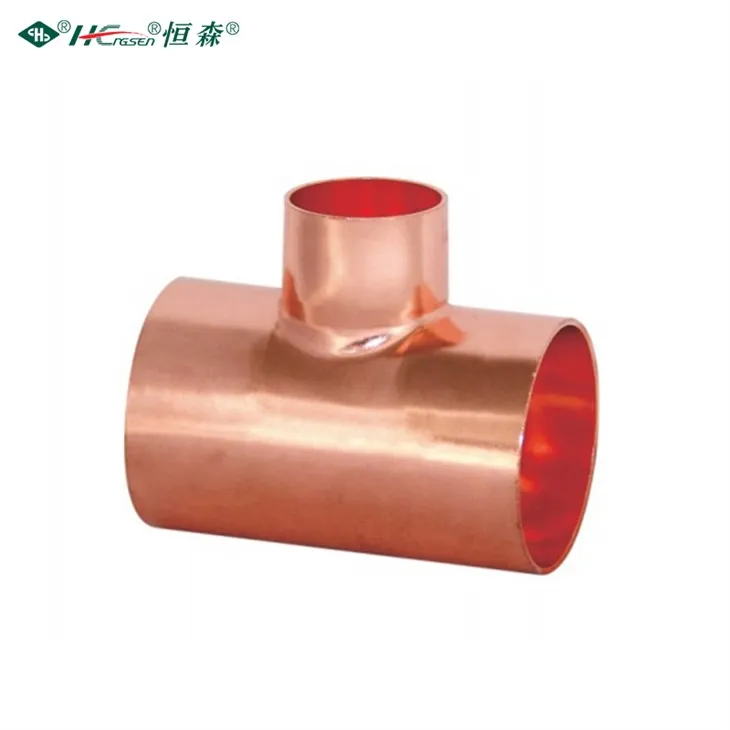
2. Core functions and technical advantages of copper tees
Core functions:
Fluid distribution: Evenly distribute the fluid in the main pipe to multiple branches to ensure stable flow in each branch.
Pressure regulation: Through pipe diameter changes and structural design, fluid shock is alleviated and system pressure fluctuations are reduced.
Direction control: Change the flow direction of the fluid to adapt to the needs of complex pipeline layout.
Technical advantages:
Corrosion resistance: An oxide film is formed on the surface of the copper alloy to resist erosion by water, gas and chemical media, extending the service life.
High strength and ductility: Withstand high pressure environments (such as fire protection systems) and adapt to pipe expansion caused by temperature changes.
Precision adaptability: Standardized interfaces (such as NPT, BSP) ensure reliable connection with pipes of different materials and reduce the risk of leakage.
3. Application scenarios and industry value of copper tees
Construction and municipal engineering:
Water supply system: In high-rise buildings, copper tees distribute tap water from the main riser to the branches on each floor to ensure stable water supply.
Drainage system: Used to connect drainage branches in bathrooms and kitchens to prevent odor backflow and pipe blockage.
Fire protection system: Connect the fire main pipeline with fire hydrants and sprinkler heads to ensure that high-pressure water flows quickly to the fire source in case of fire.
Industrial manufacturing:
Chemical pipelines: When transporting corrosive liquids (such as acids and alkalis), the chemical resistance of copper tees ensures system safety.
Cooling circulation system: In power generation equipment and injection molding machines, copper tees divert coolant to various heat dissipation points to maintain stable equipment temperature.
Agriculture and irrigation:
Drip irrigation system: The water from the main water pipe is distributed to the branch pipe through the copper tee with different diameters, and precise irrigation is achieved by combining valve control, with a water saving rate of more than 40%.
Farmland drainage: In low-lying areas, copper tees help build drainage networks to prevent crop waterlogging.
4. Design standards and manufacturing processes of copper tees
International standards:
ASME B36.10M: Specifies the dimensions of steel pipes and fittings, and copper tees must meet strength and tolerance requirements.
ISO 6507: Standardizes the mechanical properties and testing methods of copper alloy materials.
Manufacturing process:
Precision casting: Injecting copper liquid into the mold to form a complex structure, suitable for large-diameter tees.
CNC machining: Cutting copper rods through CNC lathes to ensure interface accuracy (tolerance ≤±0.05mm).
Surface treatment: Nickel or chrome plating to enhance corrosion resistance, or passivation treatment to prevent oxidation.
5. Selection and installation points of copper tees
Selection principles:
Material matching: select brass (general purpose), bronze (seawater resistant) or copper (high thermal conductivity) according to the properties of the fluid.
Pressure level: select tee with PN10, PN16 or higher pressure resistance level according to the maximum pressure of the system.
Interface form: threaded connection (suitable for small diameter), welding (suitable for high pressure) or flange connection (easy to disassemble).
Installation points:
Alignment: use special tools to ensure that the tee coincides with the pipeline axis to avoid stress concentration.
Sealing treatment: the threaded interface is wrapped with raw tape, and the welding interface uses argon arc welding to ensure airtightness.
Support and fixation: in long-distance pipelines, a bracket is set to reduce the mechanical stress on the tee.
6. Market trends and future prospects of copper tees
Environmental protection material upgrade: develop lead-free copper alloys (such as CuZn36Pb3), comply with the RoHS directive, and reduce heavy metal pollution.
Intelligent integration: built-in pressure sensor or flow control valve to realize digital monitoring and automatic adjustment of the pipeline network.
Lightweight design: Thin-walled copper alloy and composite structure are used to reduce material consumption while maintaining strength.
Summary
As the "joint" of the fluid delivery system, the performance of the copper tee directly affects the reliability and efficiency of the pipe network. From building water supply to industrial manufacturing, from agricultural irrigation to fire emergency, copper tees continue to promote technological progress in various industries with their unique material advantages and precision design. In the future, with the development of green manufacturing and intelligent pipe networks, copper tees will achieve new breakthroughs in material innovation, functional integration and sustainability, and become the cornerstone of modern fluid engineering. Choosing high-quality copper tees and following scientific installation specifications can not only ensure the long-term stable operation of the system, but also reduce maintenance costs, creating greater economic benefits and environmental value for society.
FAQ
Q: How well does it adapt to different pipe sizes in a pipeline system?
A: It is specifically designed to adapt seamlessly to different pipe sizes. With one end having a larger diameter and the other two ends with smaller, precisely - sized openings, it can connect pipes of varying diameters without issues. This allows for easy integration into existing pipeline systems during expansion or modification projects.
Q: Can it handle high - pressure fluid flow without leakage?
A: Yes, it can handle high - pressure fluid flow without leakage when selected appropriately. The construction of the reducing tee, especially those made from high - strength materials, is designed to withstand significant pressure differentials.
Q: How easy is it to install in a complex piping network?
A: It is relatively easy to install in a complex piping network. The standard fittings and connections make it simple to integrate with existing pipes. With proper planning and the right tools, plumbers and installers can quickly insert it into the pipeline, minimizing downtime during installation or repair work.