


In the field of industrial automation and fluid control, ball valves are widely used due to their compact structure, rapid opening and closing, and excellent sealing performance. Whether in the transportation pipelines of chemical plants, or in water supply systems, HVAC systems, and natural gas pipelines, ball valves play a key role. There are many types of ball valves, among which two-way ball valves and three-way ball valves are the two most common types. Although the two are similar in appearance, their internal structures, control methods, and application scenarios are different. This article will conduct a detailed analysis of the core differences between two-way ball valves and three-way ball valves to help users make scientific and reasonable decisions during the selection process.
1. Introduction to the basic functions of ball valves
A ball valve is a rotary valve that uses a ball with a through hole as an opening and closing part. Its working principle is to open and close the valve by rotating the ball. A 90-degree rotation can switch from fully open to fully closed. This quarter-turn structure makes the ball valve very fast to operate, with low resistance and strong flow capacity. Thanks to this structural feature, ball valves are widely used in pipeline systems that require fast switching or frequent operations.
2. Characteristics and Application of Two-way Ball Valve
The two-way ball valve is the most common form of ball valve, with two ports, which serve as the inlet and outlet of the medium. The internal ball has a through-hole. When the handle is rotated 90 degrees, the opening and closing operation can be quickly realized, thereby controlling the on and off of the medium. Due to its simple structure, convenient operation and low maintenance cost, the two-way ball valve is widely used in various fluid systems that require switch control.
The main features are as follows:
Compact structure and high reliability: The structure of the two-way ball valve is relatively simple, small in size, easy to install, and suitable for use in places with limited space.
Rapid opening and closing, simple operation: Only 90 degrees of rotation is required to complete the switch operation, with fast response speed, suitable for systems that need to quickly cut off the fluid.
Excellent sealing performance: The floating ball or fixed ball structure is adopted, combined with high-performance sealing materials such as PTFE, to achieve air-tight or liquid-tight tight closure.
Strong flow capacity and low flow resistance: The internal channel is designed in a linear shape, and the pressure loss is small when the fluid passes through, which is suitable for scenes with high requirements for flow rate and efficiency.
Strong adaptability: It can be used for a variety of media such as water, air, oil, natural gas, corrosive liquids, etc. The material selection is flexible, and stainless steel, brass, PVC and other materials can be selected according to different working conditions.
Typical application areas include:
Media opening and closing in industrial automation control systems
Inlet and outlet water pipelines in water treatment projects
Compressed air systems and vacuum systems
Liquid or gas control in chemical production
Hot and cold water pipe networks and HVAC equipment in civil buildings
3. Structure and function of three-way ball valve
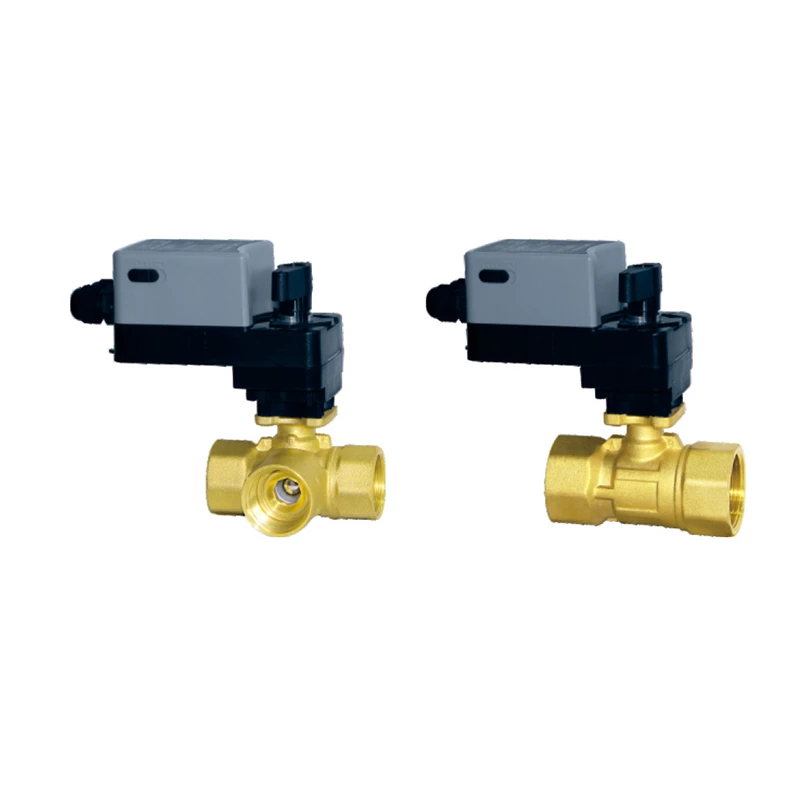
As the name implies, the three-way ball valve has three connection ports, which can realize the switching, diversion or mixing of fluids. According to the different shapes of the openings in the ball, the three-way ball valve is generally divided into two structures: L-type and T-type.
1. L-type three-way ball valve
The L-type three-way ball valve realizes the switching of fluid from one inlet to two different outlets through the internal "L"-shaped channel. Its typical function is direction switching, that is, guiding the fluid between two directions. This structure is often used in occasions where fluid flow direction is controlled in automation equipment.
2. T-type three-way ball valve
The T-type three-way ball valve has a "T"-shaped channel that can be arbitrarily connected between the three ports. It can realize the mixing of fluids between two channels, and can also realize the distribution of one inlet to two outlets. Its function is more complex and is often used in systems that require fluid mixing, distribution or bypass.
The advantages of the three-way ball valve include:
One valve for multiple uses, saving installation space
Flexible operation, can achieve multi-directional control through manual, electric or pneumatic drive
Applicable to chemical process control, steam system, hot and cold water switching and other occasions
4. The core difference between two-way and three-way ball valves
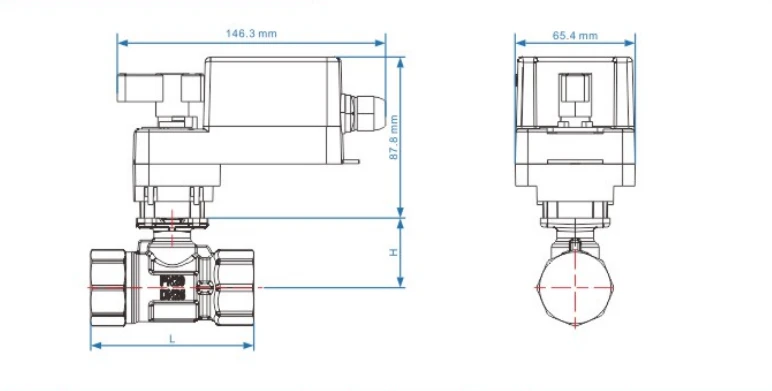
Although two-way ball valves and three-way ball valves have similarities in basic structure and working principle, their functional positioning and applicable scenarios are significantly different. Simply put, two-way ball valves are only used to control the opening and closing of a fluid channel, while three-way ball valves are used to control the path distribution, direction conversion or mixing of fluids. Two-way ball valves are suitable for single flow control scenarios, such as domestic water supply systems; while three-way ball valves are more suitable for complex processes that need to switch or merge between multiple paths, such as industrial cooling systems or process fluid distribution networks.
In addition, the cost, design and operation of three-way ball valves are relatively more complex, and multiple factors such as medium characteristics, switching frequency, pressure level and sealing requirements need to be considered when selecting.
5. Conclusion: How to choose the right type of ball valve?
Overall, whether to choose a two-way ball valve or a three-way ball valve depends on the fluid control requirements of the system. If the system only needs simple on-off control, a two-way ball valve can meet the requirements; if the system needs to control multiple flow directions or mix and divert, a three-way ball valve should be selected, especially L-type or T-type structure can be selected according to the needs. Engineering designers should make scientific selections based on specific application scenarios, pipeline layout and automation requirements.
Although the ball valve is small, it is related to the operating efficiency and safety of the entire system. Reasonable selection can not only improve the system control efficiency, but also help reduce maintenance costs and failure rates.
6. Company Recommendation
Zhejiang Hengsen Industrial Group Co., Ltd. is a modern valve company integrating R&D, manufacturing, sales and service, focusing on providing high-quality fluid control solutions for the field of industrial automation. Relying on advanced production equipment and strict quality management system, the company is committed to creating valve products with stable performance, long service life and adaptability to diversified working conditions.
1. Rich product series to meet diverse needs
Hengsen provides a variety of valve series including two-way ball valves, three-way ball valves, electric ball valves, butterfly valves, gate valves, check valves, etc., which are widely used in petrochemical, metallurgy, electric power, environmental protection, water treatment, HVAC, food and pharmaceutical industries. In particular, for the characteristics of different media, Hengsen can provide valves made of various materials such as stainless steel, alloy steel, copper alloy and plastic to ensure that the valves still maintain excellent performance under harsh working conditions such as corrosion, high temperature and high pressure.
2. Highly customized capabilities
Facing the process requirements of different customers, Hengsen has a professional R&D team that can design exclusive valve solutions based on the technical parameters and flow charts provided by customers. Whether it is the connection method, sealing structure, drive form of the valve, or the application of special materials, Hengsen can flexibly customize to ensure the best match between the valve and the system, and improve the operating efficiency and stability of the overall system.
3. Technical support and after-sales service
Hengsen not only provides high-quality products, but also pays attention to pre-sales technical support and after-sales service. The company has a professional technical team to provide customers with valve selection guidance, installation and commissioning solutions, and maintenance suggestions. The after-sales service network covers the whole country and responds quickly to help customers solve various problems encountered during use, minimize equipment downtime, and ensure customer production benefits.
With excellent product quality and a complete service system, Zhejiang Hengsen Industrial Group Co., Ltd. has become a long-term partner of many large-scale engineering projects and well-known companies. Whether it is a standard ball valve or a complex process valve, Hengsen can provide professional, efficient and reliable overall solutions to help customers achieve efficient, stable and safe production goals.